
Why Corsa is redefining how modern fintech infrastructure is built
Financial crime has evolved faster than the systems built to detect it. Modern fintechs operate across multiple rails and vendors: fiat payments, on-chain transfers, custody, PSPs, cards, banks, and identity providers. Yet much of the industry still monitors transactions as if they were standalone rows in a table.
That mismatch creates a predictable set of problems:
Rules become shallow because they can only “see” shallow data.
False positives rise because the system lacks disambiguating context.
Investigations slow down because analysts must assemble that context manually.
Corsa is designed to ingest and normalize inputs from every vendor participating in financial activity within an institution into a unified data layer. This includes client onboarding state (KYC/KYB attributes, documents, decisions), account and wallet topology (bank accounts, custody, crypto wallets, relationships), vendor intelligence signals (blockchain analytics, identity verification, custody and infrastructure signals), and graph/time-series representations (relationship risk propagation, rolling aggregates, velocity modeling, anomaly surfaces).
This engineering approach changes how policies are executed. Instead of approximating risk based on isolated attributes such as amount, currency, or geography, teams can encode logic that reflects operational topology and behavioral patterns. For example, a policy may generate an alert when a transaction involves a counterparty linked — through several degrees of graph traversal — to a high-risk entity.
Why full system context matters
Consider a transaction that looks suspicious on amount and velocity alone. In most systems, the rule fires, an alert is created, and an analyst begins assembling context: who is the client, what is their KYB profile, what is the counterparty risk, what did vendors report, and what has happened historically?
In Corsa, that same context is available at evaluation time. The rule can decide differently based on whether the counterparty is a known trusted partner, whether onboarding flagged the customer’s corporate structure, whether a linked entity has been tagged high-risk, or whether blockchain attribution indicates exposure to a sanctioned cluster. The rule is not “smarter” because it is more complex; it is smarter because it can see more.
Corsa’s rule builder supports evaluation on essentially any data point Corsa stores or ingests, including:
Raw fields and structured attributes (transaction fields, customer metadata)
Aggregated metrics (rolling windows, distributions, velocity, cohort thresholds)
Graph relationships (connections, N-hop patterns, inherited risk tags)
AI and anomaly signals (anomaly scoring, clustering, model-derived risk hints)
Because rules can use both enriched vendor signals and custom client-provided attributes, teams are not constrained by the vendor’s schema. This matters in enterprise environments where each institution has unique products, controls, and regulatory obligations.
Inline Decisions and Post-Settlement Monitoring
Corsa supports both modes that modern fintechs require:
Inline evaluation (pre-transfer / pre-trade / pre-settlement) to block, approve, or route for RFI/EDD in real time.
Post-settlement monitoring to generate alerts, conduct investigations, and support reporting workflows.
From alerts to programmable actions
Traditional platforms produce binary outputs — alert or no alert — pushing operational decision-making outside the system boundary.
Corsa expands the execution surface so monitoring functions as an active control layer. Policies can generate alerts, but also initiate state transitions and workflows such as:
Blocking or routing (block, manual review, EDD/RFI)
Risk scoring updates (client score changes based on new evidence)
Workflow execution (create cases, notify, request information, orchestrate steps)
The workflow engine allows institutions to operate directly on modeled entities — clients, transactions, alerts, cases, and notifications — encoding response logic into the platform itself so execution is deterministic, auditable, and repeatable.
How do we do it?
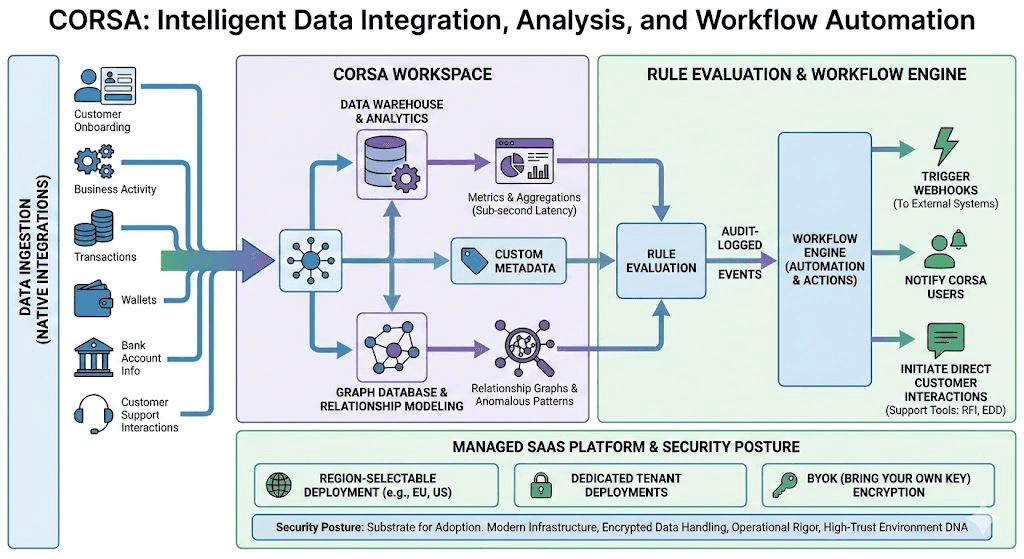
Corsa’s native integrations let you ingest as much data as you need - across every aspect of your business - directly into your workspace. This includes customer onboarding data, business activity, transactions, wallets, bank account information, and even customer support interactions.
All data is parsed and stored in our data warehouse, where metrics and aggregations are automatically generated and evaluated across your entire workspace with sub-second latency. In parallel, the same data is modeled in a graph database, enabling comprehensive relationship graphs that uncover suspicious behavior and anomalous patterns across both activity and transaction volumes.
Corsa also allows you to attach custom metadata to any entity and evaluate rules directly against your own enriched data model.
Every rule evaluation is fully audit-logged and treated as an event. These events can trigger actions through Corsa’s workflow engine - such as sending webhooks to your systems, notifying other Corsa users, or initiating direct customer interactions via your support tools for RFI, EDD, and similar processes.
Corsa is delivered as a fully managed SaaS platform with options that align with regulated enterprise requirements:
region-selectable deployment (e.g., EU and US)
dedicated tenant deployments
BYOK for encrypting PII and sensitive data
Security posture is not a set of checkboxes; it is the substrate that enables adoption. Corsa is designed with modern infrastructure patterns, encrypted data handling, and the operational rigor expected by financial institutions. The engineering team’s security DNA is rooted in building for high-trust environments, including backgrounds from security-first companies.
Systems must reflect operational reality
Compliance is not getting simpler because the systems around it are getting more complex. Data is fragmented across vendors, rails, and internal services. Typologies evolve faster than static rules. Latency, explainability, and auditability are no longer trade-offs - you need all three at once.
Legacy transaction monitoring platforms were not engineered for this reality. They operate as detached threshold engines, fed by partial datasets, evaluated in isolation, and retrofitted with workflows after the fact. That architecture fundamentally limits what they can detect, how fast they can react, and how confidently teams can defend their decisions.
Corsa is context-native by design: graph-aware, vendor-integrated, real-time, and defensible at an engineering level. This is the foundation Corsa is building—an Agentic Operating System for modern fintechs, where transaction monitoring evolves from static detection into programmable, auditable control, operating at the same speed and complexity as the business itself.

Upgrade your compliance operations instantly, with no technical debt or complex setup.
