How to Use AI for SAR Drafting: A Regulator-Approved Implementation Guide
TLDR: SAR narrative drafting consumes up to 70% of an AML investigator's working time, yet the mechanical work of pulling transaction data, sequencing events, and structuring fact patterns adds no analytical value. AI-assisted drafting removes this burden so investigators can focus on judgment, pattern recognition, and narrative quality, the things that make a SAR genuinely useful to law enforcement.
Best For: AML investigators, MLROs, financial crime investigation leads, and compliance technology buyers at fintechs, digital banks, neobanks, payment companies, and any financial institution filing more than a few hundred SARs per year.
Date: May 8, 2026
AI-assisted SAR drafting is a compliance workflow capability that uses large language models and structured case data to generate first-draft Suspicious Activity Report narratives, allowing human investigators to focus review time on analytical judgment rather than mechanical document construction. As FinCEN SAR volumes surpass 4.7 million annual filings while compliance headcount grows far more slowly, the gap between institutional SAR obligations and investigator capacity is becoming a defining operational risk for modern financial institutions. The institutions closing that gap are not hiring their way out of it. They are automating the drafting layer.
Why SAR Narrative Writing Has Become a Productivity Crisis
Financial institutions face a structural mismatch between SAR volume and investigator capacity that no amount of hiring can fully resolve.
FinCEN reported 4.7 million SAR filings in fiscal year 2024, averaging 12,870 filings per day across all reporting institutions. Depository institutions alone are tracking toward higher volumes in 2025, with banks, savings associations, and credit unions filing more than 2.193 million SARs in 2025, up 7.66% over the prior year, according to Forvis Mazars. Since 2020, total SAR filings have risen by more than 51.8%. Investigator headcount has not kept pace.
The Hidden Cost: 21 Hours Per SAR
Most compliance leaders significantly underestimate how long a SAR actually takes to complete. FinCEN's own estimate of 1.98 hours per report has long been the benchmark embedded in regulatory cost-benefit analyses. A Bank Policy Institute survey conducted in April 2024 found the real number to be 21.41 hours on average, more than ten times the agency's estimate.
The gap exists because FinCEN's figure covers only the final form-completion stage. It excludes the upstream work: alert review, KYC data retrieval, counterparty research, transaction sequencing, typology identification, and the iterative narrative drafting that precedes any formal submission. According to Abrigo's AML productivity research, investigators can spend 60% or more of their time on counterparty research alone, seeking to understand the other side of their customers' transactions before a single word of the narrative is written.
Burnout Is Becoming a Structural Risk
The productivity pressure on investigation teams is not just an efficiency problem. It is a retention and mental health problem. According to research cited by Greenlite.ai, 42% of AML compliance professionals have considered leaving their current role due to burnout, and a study published in the Journal of Financial Compliance found a 30% increase in reported mental health issues among financial crime prevention professionals between 2020 and 2023.
LexisNexis Risk Solutions' 2024 True Cost of Financial Crime Compliance study placed the total annual cost of financial crime compliance in the United States and Canada at $61 billion, with labor representing the largest single cost component. When experienced investigators leave, they take institutional knowledge, typology recognition, and SAR quality with them. Automation that reduces mechanical burden is, at least in part, a talent retention tool.
Volume Is Outpacing Everything Else
The challenge is not static. Cyber-related SAR filings grew 30% in a single year, according to FinCEN's fiscal year data, reflecting the expansion of reportable activity into digital channels. Stablecoin and crypto-related suspicious activity adds new complexity. Real-time payment rails compress the window for detection. Each of these trends increases per-SAR complexity, and therefore per-SAR drafting time, even before volume growth is factored in.
What Is AI-Assisted SAR Drafting?
AI-assisted SAR drafting is the use of generative AI models to produce structured first-draft narratives from case data, reducing the time investigators spend on mechanical document construction without removing human judgment from the final output.
The core insight is that most of what makes SAR drafting time-consuming is not analytical. Pulling KYC records, organizing transaction chronologies, identifying the relevant entity relationships, and structuring a narrative around the Five Ws (who, what, where, when, and why) are largely pattern-following tasks. A well-designed AI system can do all of this in seconds from structured case data, producing a draft that a human investigator can then review, refine, and own.
According to NICE Actimize's generative AI research, AI-assisted SAR filing can deliver up to 70% time savings. A Harvard Business School study on AI-augmented knowledge work found that AI users completed tasks 25.1% faster with quality scores more than 40% higher than unassisted peers.
What AI Handles vs. What Humans Must Own
The boundary between AI and human work in SAR drafting is not a question of capability. It is a question of accountability.
AI is well-suited to: aggregating structured transaction data into a chronological sequence, surfacing relevant KYC fields and entity relationships, drafting the "what happened" sections of the narrative, flagging typology matches from known financial crime patterns, and generating a complete first draft covering all required disclosure fields.
Human investigators must own: the judgment call on whether activity is genuinely suspicious, the analytical layer that connects behavioral patterns to plausible criminal typologies, the accuracy review of all AI-generated facts, and the final signed submission. Regulators expect human accountability at the point of filing. AI is the drafting assistant. The investigator is the author.
The Three-Layer Architecture
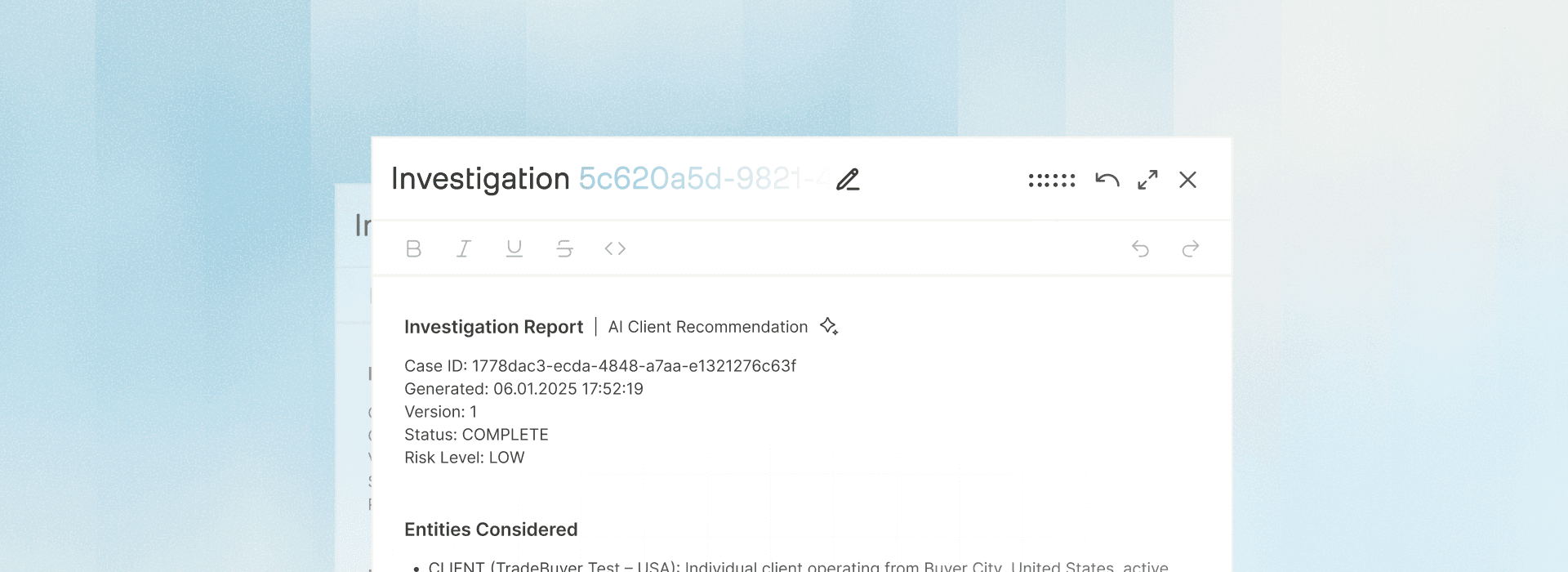
Effective AI-assisted SAR programs operate on three layers. The first is data aggregation, where the system pulls transaction records, KYC data, alert details, and prior SAR history into a structured case file. The second is narrative generation, where the AI model produces a first-draft narrative from that structured input, organized around the Five Ws standard. The third is human review, where the investigator reads, edits, and approves the narrative before submission, and documents their oversight for the audit trail.
The audit trail is not optional. FFIEC BSA/AML examination guidance requires that SAR narratives clearly describe the extent and nature of suspicious activity. Examiners increasingly expect documentation of how narratives were produced, particularly when AI tooling is involved.
How to Implement AI SAR Automation: A Five-Step Framework
Implementing AI-assisted SAR drafting requires sequencing the work carefully, starting with workflow clarity before any technology selection.
Step 1: Audit Your Current SAR Workflow
Before selecting any tooling, map the existing workflow in detail. Identify where investigator time goes at each stage: alert triage, case opening, evidence collection, counterparty research, narrative drafting, quality review, and submission. Quantify time spent at each stage using a sample of recent cases. The goal is to identify exactly which steps are mechanical enough for AI to assist and which require investigator judgment to remain human.
Most teams find that 50 to 70% of total case time is spent on steps that are primarily data retrieval and document construction, not analysis. That is the addressable surface for automation.
Step 2: Define the Human-AI Handoff
Before piloting any tool, write down the exact point at which the AI draft enters the investigator's workflow and the exact review steps the investigator must complete before submission. This is not a bureaucratic exercise. It is the governance document that will matter when an examiner asks how your SAR narratives were produced.
The handoff definition should specify: what structured inputs the AI receives, what the investigator must verify in the draft, what they must add or modify to reflect their own judgment, and how they document their review. FinCEN's SAR narrative guidance remains the benchmark for completeness. Your AI implementation should be measured against it.
Step 3: Select Your Tooling
The market for AI-assisted SAR drafting tools ranges from standalone narrative assistants to fully integrated compliance platforms with agentic case management. Evaluation criteria should include: quality of first-draft output on your actual case types, explainability of AI-generated content, audit logging at the field level, integration with your existing case management system, and the vendor's ability to demonstrate regulator-grade documentation practices.
Avoid tools that generate narrative text without a traceable connection to the underlying case data. If an examiner asks where a specific fact in the SAR came from, you need to be able to point to the source.
Step 4: Run a Controlled Pilot
Start with a defined cohort of case types, ideally those with high volume and relatively standardized fact patterns (structuring, layering, high-velocity account activity). Run AI-assisted drafting in parallel with your existing workflow for four to six weeks. Track three metrics: time-to-first-draft, investigator net edit time, and SAR quality scores assessed against your internal checklist.
The parallel run matters because it surfaces edge cases your workflow audit missed. Cases with unusual typologies, cross-border complexity, or politically exposed person involvement will stress-test the AI's drafting quality before you rely on it at scale.
Step 5: Build Explainability In from Day One
Explainability in AI SAR drafting means two things. First, the AI system must be able to show, for any statement in the generated narrative, which data point it drew from. Second, the investigator must be able to articulate, in plain language, why they accepted or modified each part of the AI-generated draft.
FinCEN's 2025 SAR guidance update placed renewed emphasis on quality of information rather than quantity, signaling that regulators are watching for narrative completeness and accuracy more closely than ever. An AI system that generates plausible but unsourced narrative text creates regulatory risk, not efficiency. Explainability infrastructure is not a nice-to-have. It is the difference between a defensible AI implementation and a liability.
What Good Looks Like: Quality Benchmarks for AI-Assisted SARs
Quality in AI-assisted SAR drafting is not just about speed. It is about producing narratives that are more useful to law enforcement than what manual drafting typically delivers.
The Five Ws Standard
FinCEN's SAR narrative guidance has long centered on the Five Ws: who conducted the suspicious activity, what instruments or mechanisms were used, where the activity occurred, when it occurred, and why the institution believes the activity is suspicious. A well-implemented AI drafting system should reliably cover all five dimensions on every SAR, which is something that time-pressured manual drafting frequently fails to do.
The FFIEC BSA/AML Examination Manual states that incomplete or disorganized narratives make further analysis difficult, if not impossible, for law enforcement. AI that consistently produces Five-W-complete narratives represents a measurable quality improvement over the manual baseline at most institutions.
Narrative Completeness vs. Narrative Length
A common mistake in evaluating AI SAR output is equating length with quality. Examiners do not want longer SARs. They want complete ones. The test is not word count. It is whether the narrative provides actionable intelligence: the right entity identifiers, the specific transaction references, and the clear articulation of why the activity pattern is suspicious rather than unusual.
Use your pilot data to score AI-generated drafts on completeness dimensions, not length. Institutions that have deployed AI-assisted drafting report that first drafts are often more complete than manual drafts produced under time pressure, because the AI does not skip fields or summarize transaction sequences that a fatigued investigator might compress.
Governance, Explainability, and What Examiners Are Looking For
Regulators are paying attention to AI in the SAR workflow, and the governance standard is evolving quickly.
What Examiners Actually Look For
Examiners reviewing SAR programs that use AI assistance are focused on three things. First, does the institution have a documented policy covering AI use in SAR production? Second, is there evidence that a human investigator reviewed and took responsibility for every submitted SAR? Third, are the AI-generated components of the narrative traceable to source data?
The Celent and NICE Actimize research on AI in financial crime compliance found that banks increasingly view GenAI for AML not as a risk to be managed but as a capability to be governed, with documentation practices becoming a competitive differentiator in examination outcomes.
Documenting AI Involvement
The documentation standard for AI-assisted SAR production should include: the version of the AI model used, the input data fields provided to the model, a record of all investigator edits to the AI-generated draft, and the investigator's sign-off confirming their review and ownership of the final narrative. This documentation does not need to be voluminous. It needs to be complete and retrievable.
For institutions building this capability now, Corsa Finance's agentic compliance platform provides the audit logging, explainability layer, and investigator workflow tooling that this governance standard requires. Teams interested in how agentic AI handles the broader investigation workflow, from alert triage through SAR submission, can explore our guide to agentic AI for AML and our transaction monitoring modernization framework.
The institutions that implement AI SAR drafting well will file more complete reports, do it faster, and be able to demonstrate to examiners exactly how each narrative was produced. That combination, speed with quality and defensible governance, is the standard the next generation of compliance operations is being built around.

Upgrade your compliance operations instantly, with no technical debt or complex setup.
