The Compliance CRM: A Missing Layer in Modern Fintech Infrastructure
Jan 6, 2026
For years, fintech infrastructure has evolved rapidly - payments stacks, data platforms, developer tooling, fraud engines, and financial operations systems have all matured at incredible speed. But one critical layer has been consistently overlooked:
A purpose-built CRM for compliance.
Most compliance teams today still operate without a true system of record for customer risk, investigations, and regulatory context. Instead, they rely on a patchwork of internal tools, spreadsheets, case management systems, vendor dashboards, and repurposed platforms like Salesforce or Retool - none of which were designed for the realities of modern compliance operations.
As fintechs scale across geographies, products, and regulatory regimes, this gap becomes one of the most dangerous forms of technical debt in the organization.
Why Traditional CRMs Fail Compliance Teams
Traditional CRMs were built for sales and customer success.
They track contacts, deals, conversations, and pipelines - not risk.
Compliance teams, on the other hand, need to manage:
identity and entity structures
KYC / KYB and ongoing due diligence
transaction histories across fiat and blockchain
sanctions, fraud, and behavioral signals
alerts and investigations
regulatory filings and audit trails
Trying to force this complexity into generic CRMs or internal admin tools creates operational drag, blind spots, and significant regulatory risk. Teams spend more time stitching data together than actually analyzing risk.
The result is predictable: manual processes, duplicated work, fragmented visibility, and constant reliance on engineering just to keep the lights on.
Why Traditional CRMs Fail Compliance Teams
A true compliance CRM is not just about storing customer records.
It must become the system of intelligence and action for compliance and risk teams.
At its core, a compliance CRM must provide:
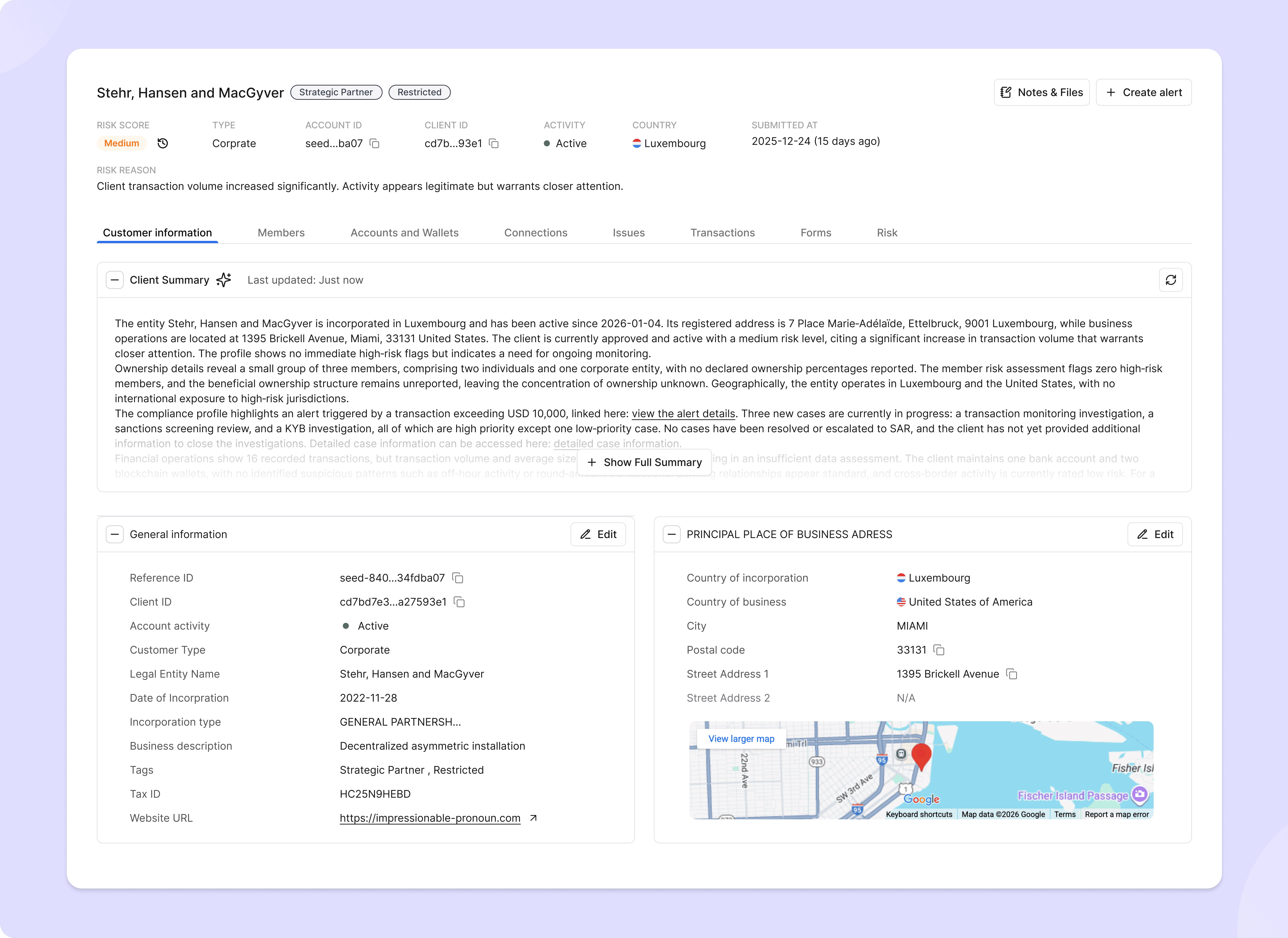
A unified customer profile
Every user, business, and counterparty represented through a single, dynamic record - enriched by data from onboarding, KYC/KYB, transaction monitoring, blockchain analytics, fraud systems, internal tools, and vendor platforms.
Continuous risk context
Risk is not static. It evolves with behavior, transactions, counterparties, alerts, and regulatory exposure. A compliance CRM must track how and why risk changes over time.
Native collaboration
Investigations, notes, documents, escalations, approvals, and decisions must live directly on the customer record - not scattered across inboxes, Slack threads, and shared drives.
Operational control
The CRM must connect directly to workflows: triage, investigations, EDD, RFIs, monitoring rules, reporting, and filings – with full auditability and governance.
This is not a reporting layer.It is the operational backbone of compliance.
How Corsa Rebuilds the Compliance CRM
Corsa’s Compliance CRM was built from the ground up as the core module of the Corsa Operating System.
Instead of retrofitting compliance into tools that were never designed for it, Corsa provides an out-of-the-box system of record that unifies:
identity and onboarding data and documents
sanctions and screening results
AML and fraud signals
fiat and blockchain transaction activity
alerts, cases, and regulatory history
Network analysis and indirect connections across your customers
documents, communications, and internal records
Customer support communications
Cross team collaboration, notes and comments
All of this information is organized into a single, live customer profile that evolves in real time as new data arrives.
On top of this foundation, Corsa layers AI-driven insights that summarize customer behavior, explain risk changes, surface anomalies, and assist investigations - allowing teams to move from reactive processing to proactive risk management.
Why This Layer Matters More Than Ever
As fintechs expand into new markets, launch new products, and support both fiat and digital asset flows, compliance operations are becoming one of the most complex functions in the company.
Without a real compliance CRM:
leadership lacks true visibility into risk exposure
teams struggle to scale, grow across geos and product lines without adding headcount
audits become fire drills
and compliance becomes a bottleneck to growth
With the right system of record in place, compliance transforms from an operational burden into a strategic advantage.
The New Standard for Compliance Infrastructure
The compliance CRM is no longer optional infrastructure for regulated fintechs.
It is the foundation upon which scalable, intelligent, and resilient compliance operations are built.
This missing layer is now being filled.
And once teams experience a real compliance CRM, it becomes very difficult to imagine operating without one.

AI-first compliance operating system for regulated fintechs.
Products
© 2025 Corsa. All rights reserved.

AI-first compliance operating system for regulated fintechs.
Products
© 2025 Corsa. All rights reserved.

AI-first compliance operating system for regulated fintechs.
Products
© 2025 Corsa. All rights reserved.

AI-first compliance operating system for regulated fintechs.
Products
© 2025 Corsa. All rights reserved.

AI-first compliance operating system for regulated fintechs.
Products
© 2025 Corsa. All rights reserved.
The Compliance CRM: A Missing Layer in Modern Fintech Infrastructure
Jan 6, 2026
For years, fintech infrastructure has evolved rapidly - payments stacks, data platforms, developer tooling, fraud engines, and financial operations systems have all matured at incredible speed. But one critical layer has been consistently overlooked:
A purpose-built CRM for compliance.
Most compliance teams today still operate without a true system of record for customer risk, investigations, and regulatory context. Instead, they rely on a patchwork of internal tools, spreadsheets, case management systems, vendor dashboards, and repurposed platforms like Salesforce or Retool - none of which were designed for the realities of modern compliance operations.
As fintechs scale across geographies, products, and regulatory regimes, this gap becomes one of the most dangerous forms of technical debt in the organization.
Why Traditional CRMs Fail Compliance Teams
Traditional CRMs were built for sales and customer success.
They track contacts, deals, conversations, and pipelines - not risk.
Compliance teams, on the other hand, need to manage:
identity and entity structures
KYC / KYB and ongoing due diligence
transaction histories across fiat and blockchain
sanctions, fraud, and behavioral signals
alerts and investigations
regulatory filings and audit trails
Trying to force this complexity into generic CRMs or internal admin tools creates operational drag, blind spots, and significant regulatory risk. Teams spend more time stitching data together than actually analyzing risk.
The result is predictable: manual processes, duplicated work, fragmented visibility, and constant reliance on engineering just to keep the lights on.

Why Traditional CRMs Fail Compliance Teams
A true compliance CRM is not just about storing customer records.
It must become the system of intelligence and action for compliance and risk teams.
At its core, a compliance CRM must provide:
A unified customer profile
Every user, business, and counterparty represented through a single, dynamic record - enriched by data from onboarding, KYC/KYB, transaction monitoring, blockchain analytics, fraud systems, internal tools, and vendor platforms.
Continuous risk context
Risk is not static. It evolves with behavior, transactions, counterparties, alerts, and regulatory exposure. A compliance CRM must track how and why risk changes over time.
Native collaboration
Investigations, notes, documents, escalations, approvals, and decisions must live directly on the customer record - not scattered across inboxes, Slack threads, and shared drives.
Operational control
The CRM must connect directly to workflows: triage, investigations, EDD, RFIs, monitoring rules, reporting, and filings – with full auditability and governance.
This is not a reporting layer.It is the operational backbone of compliance.
How Corsa Rebuilds the Compliance CRM
Corsa’s Compliance CRM was built from the ground up as the core module of the Corsa Operating System.
Instead of retrofitting compliance into tools that were never designed for it, Corsa provides an out-of-the-box system of record that unifies:
identity and onboarding data and documents
sanctions and screening results
AML and fraud signals
fiat and blockchain transaction activity
alerts, cases, and regulatory history
Network analysis and indirect connections across your customers
documents, communications, and internal records
Customer support communications
Cross team collaboration, notes and comments
All of this information is organized into a single, live customer profile that evolves in real time as new data arrives.
On top of this foundation, Corsa layers AI-driven insights that summarize customer behavior, explain risk changes, surface anomalies, and assist investigations - allowing teams to move from reactive processing to proactive risk management.
Why This Layer Matters More Than Ever
As fintechs expand into new markets, launch new products, and support both fiat and digital asset flows, compliance operations are becoming one of the most complex functions in the company.
Without a real compliance CRM:
leadership lacks true visibility into risk exposure
teams struggle to scale, grow across geos and product lines without adding headcount
audits become fire drills
and compliance becomes a bottleneck to growth
With the right system of record in place, compliance transforms from an operational burden into a strategic advantage.
The New Standard for Compliance Infrastructure
The compliance CRM is no longer optional infrastructure for regulated fintechs.
It is the foundation upon which scalable, intelligent, and resilient compliance operations are built.
This missing layer is now being filled.
And once teams experience a real compliance CRM, it becomes very difficult to imagine operating without one.


The Compliance CRM: A Missing Layer in Modern Fintech Infrastructure
Jan 6, 2026
For years, fintech infrastructure has evolved rapidly - payments stacks, data platforms, developer tooling, fraud engines, and financial operations systems have all matured at incredible speed. But one critical layer has been consistently overlooked:
A purpose-built CRM for compliance.
Most compliance teams today still operate without a true system of record for customer risk, investigations, and regulatory context. Instead, they rely on a patchwork of internal tools, spreadsheets, case management systems, vendor dashboards, and repurposed platforms like Salesforce or Retool - none of which were designed for the realities of modern compliance operations.
As fintechs scale across geographies, products, and regulatory regimes, this gap becomes one of the most dangerous forms of technical debt in the organization.
Why Traditional CRMs Fail Compliance Teams
Traditional CRMs were built for sales and customer success.
They track contacts, deals, conversations, and pipelines - not risk.
Compliance teams, on the other hand, need to manage:
identity and entity structures
KYC / KYB and ongoing due diligence
transaction histories across fiat and blockchain
sanctions, fraud, and behavioral signals
alerts and investigations
regulatory filings and audit trails
Trying to force this complexity into generic CRMs or internal admin tools creates operational drag, blind spots, and significant regulatory risk. Teams spend more time stitching data together than actually analyzing risk.
The result is predictable: manual processes, duplicated work, fragmented visibility, and constant reliance on engineering just to keep the lights on.

Why Traditional CRMs Fail Compliance Teams
A true compliance CRM is not just about storing customer records.
It must become the system of intelligence and action for compliance and risk teams.
At its core, a compliance CRM must provide:
A unified customer profile
Every user, business, and counterparty represented through a single, dynamic record - enriched by data from onboarding, KYC/KYB, transaction monitoring, blockchain analytics, fraud systems, internal tools, and vendor platforms.
Continuous risk context
Risk is not static. It evolves with behavior, transactions, counterparties, alerts, and regulatory exposure. A compliance CRM must track how and why risk changes over time.
Native collaboration
Investigations, notes, documents, escalations, approvals, and decisions must live directly on the customer record - not scattered across inboxes, Slack threads, and shared drives.
Operational control
The CRM must connect directly to workflows: triage, investigations, EDD, RFIs, monitoring rules, reporting, and filings – with full auditability and governance.
This is not a reporting layer.It is the operational backbone of compliance.
How Corsa Rebuilds the Compliance CRM
Corsa’s Compliance CRM was built from the ground up as the core module of the Corsa Operating System.
Instead of retrofitting compliance into tools that were never designed for it, Corsa provides an out-of-the-box system of record that unifies:
identity and onboarding data and documents
sanctions and screening results
AML and fraud signals
fiat and blockchain transaction activity
alerts, cases, and regulatory history
Network analysis and indirect connections across your customers
documents, communications, and internal records
Customer support communications
Cross team collaboration, notes and comments
All of this information is organized into a single, live customer profile that evolves in real time as new data arrives.
On top of this foundation, Corsa layers AI-driven insights that summarize customer behavior, explain risk changes, surface anomalies, and assist investigations - allowing teams to move from reactive processing to proactive risk management.
Why This Layer Matters More Than Ever
As fintechs expand into new markets, launch new products, and support both fiat and digital asset flows, compliance operations are becoming one of the most complex functions in the company.
Without a real compliance CRM:
leadership lacks true visibility into risk exposure
teams struggle to scale, grow across geos and product lines without adding headcount
audits become fire drills
and compliance becomes a bottleneck to growth
With the right system of record in place, compliance transforms from an operational burden into a strategic advantage.
The New Standard for Compliance Infrastructure
The compliance CRM is no longer optional infrastructure for regulated fintechs.
It is the foundation upon which scalable, intelligent, and resilient compliance operations are built.
This missing layer is now being filled.
And once teams experience a real compliance CRM, it becomes very difficult to imagine operating without one.


AI-first compliance operating system for regulated fintechs.
Products
© 2025 Corsa. All rights reserved.

AI-first compliance operating system for regulated fintechs.
Products
© 2025 Corsa. All rights reserved.

AI-first compliance operating system for regulated fintechs.
Products
© 2025 Corsa. All rights reserved.

AI-first compliance operating system for regulated fintechs.
Products
© 2025 Corsa. All rights reserved.

AI-first compliance operating system for regulated fintechs.
Products
© 2025 Corsa. All rights reserved.
